Shennong: The Mythical Father of Agriculture and Chinese Medicine
Just like the perfect blend of tea, the origin of tea comes with a blend of history and myth. The origin of tea can be traced back to ancient China around 2737 BCE.
Legend has it that Emperor Shennong, “The Divine Healer” accidentally discovered tea around 3,000 BC. He was a mighty leader with the head of a bull and the body of a man. He spoke within three days of his birth and walked within a week.
One day, the emperor and his entourage made camp under a Camellia sinensis tree. They built a fire and prepared a cauldron with hot water.
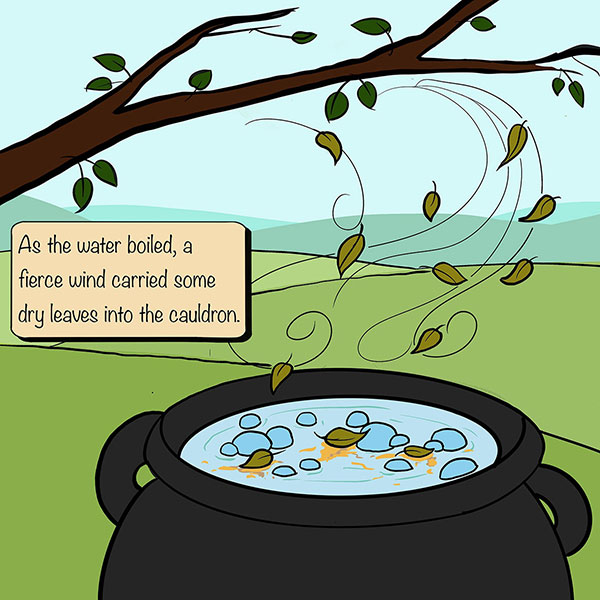
As the water boiled gently, a fierce wind from the heavens blew some dried leaves into the cauldron, giving the water a golden hue and releasing a fragrant scent.
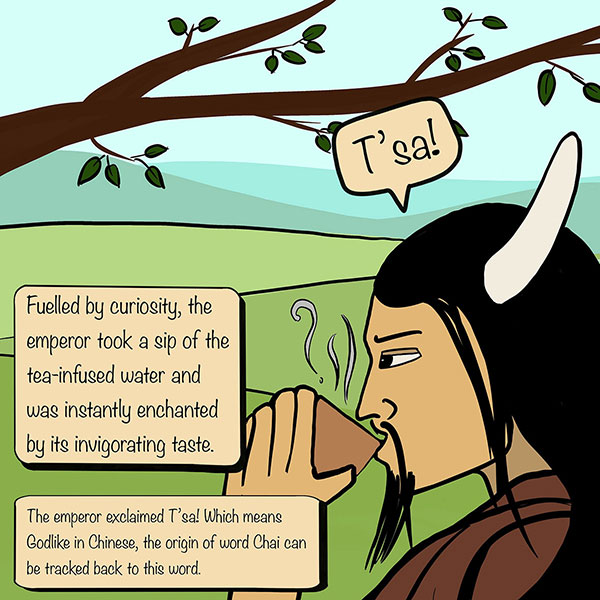
Upon sipping the tea-infused water, the Emperor was instantly enchanted by the refreshing taste and soothing aroma.
This marked the beginning of the world’s favourite beverage.
Another tale oN Origin of tea
According to another version of the origin of tea, Shennong was conceived after his mother, Nü Teng, ingested a celestial dragon’s vapour. Also, he emerged from his mother’s womb nine days after conception with a transparent belly and internal organs. He grew to be a strong leader who cared deeply for his tribe. But, the world then was riddled with hunger and diseases, leading to many deaths.
Shennong took it upon himself to find a cure for his people. He started to hike among the mountains, exploring and tasting hundreds of herbs. He assessed their medicinal value, if they were safe to consume or poisonous. Shennong was able to observe how the herbs behaved in his body thanks to his transparent internal organs and belly.
One day, while sampling the herbs, he came across 72 poisonous herbs. As strong as he was, this was too much even for him. Exhausted and weak, he collapsed to the ground, taking staggered breaths. At that moment, a wind blew a little leaf into his mouth. If this was the end for him, he made the decision to leave this world with no regrets.
Shennong desperately chewed on the leaf to satisfy his insatiable curiosity and felt the healing properties of the leaf curing the toxins from his body. Amazed by this, he decided to name this plant “cha” (Chinese: 查) meaning “inspect” or “examine”.
The origin of tea marked a crucial turning point in history and played a significant role in shaping the world we see today. Afterwards, tea has grown in popularity with each passing era, acquiring new flavours and qualities that have moulded it into what it is now in China—not simply a beverage with healing and revitalising properties, but also a cultural experience.
As you brew your next cup of tea, keep in mind that you are reliving a tradition that dates back countless centuries. A time beyond human memory, when the emperors were gods and tea, a drink of the gods!